ტური ყვარლის ულამაზეს ტბაზე :)
Tel:+995 598 760 860
Showing posts with label Tour In Georgia. Show all posts
Monday, February 8, 2016
Tel:+995 598 760 860
Tsinandali is a village in Kakheti, Georgia, noted for the estate and its historic winery which once belonged to the 19th-century aristocratic poet Alexander Chavchavadze (1786–1846). It is situated in the district of Telavi, 79 km east of Tbilisi. Alexander Chavchavadze inherited this village, lying in the Alazani River vally, from his father, Prince Garsevan. He refurbished the estate, constructed a new Italianate palace and built a decorative garden in 1835. It was the place where Chavchavadze frequently entertained foreign guests with music, wit, and – most especially – the fine vintages made at his estate winery (marani). Familiar with European ways, Chavchavadze built Georgia’s oldest and largest winery where he combined European and centuries-long Georgian winemaking traditions. The highly regarded dry white Tsinandali is still produced there. The village and the Chavchavadze estate were further famed by a surprising raid by the troops of Imam Shamil, a Muslim leader of the northeast Caucasian opposition to the Russian expansion, on July 2, 1854. The attack was commanded by Ghazi-Muhammad, Shamil’s son.
Tour In Georgia Shuamta
Tel:+995 598 760 860
Oldshuamta Georgian Orthodox monastery in the municipality, located in the forest, 7 km. Its consists of: V century, one of the most curious examples of Christian architecture in Georgia; VII century domed church, Mtskheta Cross type, but of a smaller (reduced apses and depth, a dome is increased, there is a clearly identified trompebis Construction); VII century, a small domed church. It is sort of a cross plan, but there is no longer a corner rooms and. Equal axes. The church is built of cobblestones, are used for different parts of pumice. XVI century monastery of Old & empty. Near King of II-'s (1520-1570) wife Tina Gurieli daughter Shuamta founded a new monastery. Shuamta main built of brick church plan cross-dome shaped, inside - painted. Preserved the donors' portraits. The church reopened Irakli II- m. The complex includes a chapel and other buildings. Shuamta Khakhuli Convent - late medieval Georgian Orthodox monastery in the region, present in the municipality. Located near the town of Telavi, Due to the heavy mountain slope. The monastery was founded in the XVI century, in the 50s, after the Old & Monastery was. The new monastery of King Levan's wife, founded by Tina, who became a nun and was buried at the convent Shuamta.
Tel:+995 598 760 860
Oldshuamta Georgian Orthodox monastery in the municipality, located in the forest, 7 km. Its consists of: V century, one of the most curious examples of Christian architecture in Georgia; VII century domed church, Mtskheta Cross type, but of a smaller (reduced apses and depth, a dome is increased, there is a clearly identified trompebis Construction); VII century, a small domed church. It is sort of a cross plan, but there is no longer a corner rooms and. Equal axes. The church is built of cobblestones, are used for different parts of pumice. XVI century monastery of Old & empty. Near King of II-'s (1520-1570) wife Tina Gurieli daughter Shuamta founded a new monastery. Shuamta main built of brick church plan cross-dome shaped, inside - painted. Preserved the donors' portraits. The church reopened Irakli II- m. The complex includes a chapel and other buildings. Shuamta Khakhuli Convent - late medieval Georgian Orthodox monastery in the region, present in the municipality. Located near the town of Telavi, Due to the heavy mountain slope. The monastery was founded in the XVI century, in the 50s, after the Old & Monastery was. The new monastery of King Levan's wife, founded by Tina, who became a nun and was buried at the convent Shuamta.
Tour In Georgia Ujarma CastleTel:+995 598 760 860
Ujarma - historic fortress in Georgia. Located in the north of the village Ujarma 4 km away, near Gombori secondary road, near Tbilisi and Telavi, historical and geographic province outside the region, on the right bank of the river Iori. Build Ujarma periods III-IV centuries, the king's reign aspaguris considered. To rebuild, to strengthen care Vakhtang and Dachi. The Citadel was built in the time of their powerful and durable towers, palaces and churches. After Vakhtang V- sun century fortress in one of his residence, the fortified town has undergone a revival. IV-VIII centuries a significant role in the history of the fortress. 914 Arabs in Ujarma army. After a Ujarma falling and will continue to exist as a small settlement. XII century fortress restored King George III- m (1156-1184 AD.) And its treasury shares. XIII century Mongol rule, XV century, the disintegration of the Kingdom of the Kingdom of principalities collapse gradually lowered Ujarma and a flourishing small village outside the city. Excavations of the fortress town of glass and bronze bracelets are found; Bronze rings and buttons, sazedashe pitchers, bakery, graves (XII-XIII centuries).
Tour In Georgia Sighnaghi
Tel:+995 598 760 860
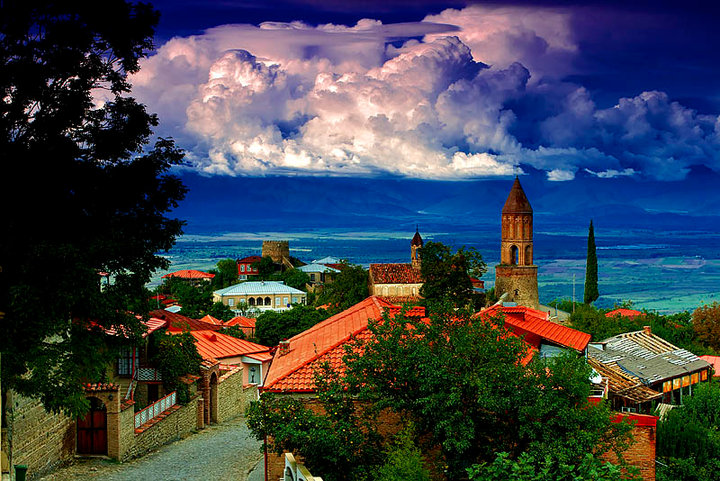
Sighnaghi is a town in Georgia's easternmost region of Kakheti and the administrative center of the Sighnaghi Municipality. It is one of the country's smallest towns with a population of 2,146 as of the 2002 census. Sighnaghi's economy is dominated by the production of wine, traditional carpets and Georgian traditional food Mcvadi. The town and its environs are also known for their landscapes and historical monuments. Sighnaghi has recently undergone a fundamental reconstruction program and has become an important center of Georgia's tourist industry. The territory of the modern-day town has been settled since the Paleolithic period and was known as Hereti in the Middle Ages, and as Kiziqi after the 15th century. Sighnaghi (literally, "shelter" in Azeri) as a settlement is first recorded in the early 18th century. In 1762, King Heraclius II of Georgia sponsored the construction of the town and erected a fortress to defend the area from marauding attacks by Dagestan tribesmen. As of the 1770 census, Sighnaghi was settled by 100 families, chiefly craftsmen and merchants. When Georgia was annexed by Imperial Russia in 1801, Sighnaghi (Signakh) was officially granted town status and became a centre of Signakh uyezd (Russian: Сигнахский уезд) within Tiflis Governorate in 1802. In 1812, Signak joined the rebellion with the rest of Kakheti against the Russian rule. During the Caucasian War, the town "was considered an important point on account of its proximity to" Dagestan. The town quickly rose in its size and population and became an agricultural center under the Soviet Union. The severe economic crisis in post-Soviet Georgia heavily affected the town, but a major reconstruction project recently launched by the Government of Georgia and co-funded by several international organizations intends to address an increasing tourist interest and modernize infrastructure. The town has an area of 2.978 km² with 24.3% being residential. Sighnaghi is approximately 113 km southeast of Tbilisi, the capital of Georgia. Sighnaghi District is adjacent, on the town’s east and southwest sides. Sighnaghi is situated in the eastern foothills of the Gombori Range, a watershed between the Iori and Alazani valleys, in a productive agricultural and fruit-growing region.
Tel:+995 598 760 860
Sighnaghi is a town in Georgia's easternmost region of Kakheti and the administrative center of the Sighnaghi Municipality. It is one of the country's smallest towns with a population of 2,146 as of the 2002 census. Sighnaghi's economy is dominated by the production of wine, traditional carpets and Georgian traditional food Mcvadi. The town and its environs are also known for their landscapes and historical monuments. Sighnaghi has recently undergone a fundamental reconstruction program and has become an important center of Georgia's tourist industry. The territory of the modern-day town has been settled since the Paleolithic period and was known as Hereti in the Middle Ages, and as Kiziqi after the 15th century. Sighnaghi (literally, "shelter" in Azeri) as a settlement is first recorded in the early 18th century. In 1762, King Heraclius II of Georgia sponsored the construction of the town and erected a fortress to defend the area from marauding attacks by Dagestan tribesmen. As of the 1770 census, Sighnaghi was settled by 100 families, chiefly craftsmen and merchants. When Georgia was annexed by Imperial Russia in 1801, Sighnaghi (Signakh) was officially granted town status and became a centre of Signakh uyezd (Russian: Сигнахский уезд) within Tiflis Governorate in 1802. In 1812, Signak joined the rebellion with the rest of Kakheti against the Russian rule. During the Caucasian War, the town "was considered an important point on account of its proximity to" Dagestan. The town quickly rose in its size and population and became an agricultural center under the Soviet Union. The severe economic crisis in post-Soviet Georgia heavily affected the town, but a major reconstruction project recently launched by the Government of Georgia and co-funded by several international organizations intends to address an increasing tourist interest and modernize infrastructure. The town has an area of 2.978 km² with 24.3% being residential. Sighnaghi is approximately 113 km southeast of Tbilisi, the capital of Georgia. Sighnaghi District is adjacent, on the town’s east and southwest sides. Sighnaghi is situated in the eastern foothills of the Gombori Range, a watershed between the Iori and Alazani valleys, in a productive agricultural and fruit-growing region.
Tour In Georgia NekresiTel:+995 598 760 860
Nekresi - Monastery in the region of kakheti. Founded by King Pharnajom (c. AD. II-I cc.). IV century king of Iberia Thrdat built a church here, where the VI century, established Abibos Nekreseli. His time was Nekresi Episcopal (XIX century it existed). Shio of the "Assyrian Fathers", who came to Georgia in the middle of the VI century, Christianity spread and led to the establishment of the East and in different parts of the process of constitution of the afterlife. Abibus father came from Syria and one time he worked with Zedazeni, and then took over the diocese Nekresi. The priesthood of the very difficult period coincided. Kartli established Persians employed every means for the introduction of paganism, which is strongly opposed by campaign Shio.Nekresi immediately given great importance. Out of circulating Kartli political and cultural influence in the eastern highlands of the Caucasus. Nekresi Episcopal diocese, also part of Dagestan (didoeti). Nekresi unleashed a cultural and educational activities. Nekreseli priests (Dositeos Cherkezishvili, Zakaria Mikadze, XVIII c., The poet-Deacon Moses, XIX c., Etc.) clamored for a writer, too.
Tour IN Georgia Ikalto academyTel:+995 598 760 860
Ikalto academy in XI-XIII centuries was a high school and the academy in Ikalto, Georgia. Ikalto monastery was known as one of the most significant cultural-scholastic centers of Georgia, which is asserted by the ruins of some civil building preserved at the site of the monastery. According to sources first academy in this area was founded in 9 AD, but during the Arab invasions it was entirely devastated. During the Georgian Renaissance teacher of David the Builder, scholar and philosopher Arsen of Ikalto initiated the idea on recreating a high school and the academy at Ikalto once again. The first rector of the Academy was Arsen himself who seems to move here from the Gelati Academy. Many important works were written and translated from Greek, important catalogues were made up like Dogmatikon ~ (the most consummated lists -1463, XII-XIII cc.) and many other works. During his activity at academy, Arsen of Ikalto translated important works such as "The Great Nomocanon", another important work translated by him was "The Source of knowledge" written by John Damascene. He wrote "The Epitaph of David the Builder". The academy of Ikalto had functioned for a long time, playing an important role in the history of Georgian enlightenment. Teaching basically followed the Trivium-Quadrivium method.
Tour In Georgia White George's ChurchTel:+995 598 760 860
White George's Church - St. George Municipal Complex in the village 2 km south of cows on a high hill. The complex includes a church, a chapel, and the walls of the auxiliary buildings. The church belongs to the fence and X-XIII centuries, the belfry - XVI century, and ancillary buildings - XIX-XX centuries is built. Church dome shaped, free-style cross, has elongated arms of the East and West. The building consists of a three-layer construction, the uadresia east arm, and the dome of the XVI century brick. In 1988, the interior was completely painted. White George celebration on August 14 (August 28, AD) held: people are three times or seven times wall, sang the glory of the team. In the church, decorated in white danced image "slaves". Some of the icons and heavy chain loaded chok all around the temple and the walls of the lighted candle was gluing. 'Door to go to bed, "the image of a slave", by entering the foot treading. After the sacrifices of slaughtered livestock, poultry, held breakfast, which often lasted for several days. The church is active and subject to Alaverdi Diocese.
Tour In Georgia Erekle II MuseumTel:+995 598 760 860
Chubinashvili Municipal Historical and Ethnographic Museum, founded in 1927 as a museum. 8 years, the museum has worked on a voluntary basis. 1935 was transformed into a historical museum. The museum is placed in a former palace of the King II- hall. Divisions have different periods. Museum Complex "was built" under the name of "Kakhetian Kings Palace" (XVIII century), the king's churches, Erekles by XVIII century 50s, founded the philosophical-theological school building remains, the king of the bath and the palace of the tunnel, and the East West's unique gates, as well as a former university of St. Nino, Kate Iashvili art gallery and administrative buildings. The museum complex includes memorial palace of the Kakheti king Erekle II (built in 1884-86), court church, re_parents of philosophy school, bath and tunnel built by Erekle II, also Ketevan Iashvili Art Gallery. The museum houses king Erekle's belongings and along with them: numismatic collection, erly medieval sarcophagus, late medieval armor, and collections of XVII-XIX c.c. cooper household objects, weapons, Khevsuretian (East Georgian mountainous region) clothes. The Art Gallery houses the private collection (187 items) of Ketevan Iashvili donated by her to the museum. The collection includes works of XIX c. Dach, French, German, Russian (Aivazovski, Kramskoi and other peredvizhnik period artists) painters, also works of Georgian artists (E.Akhvlediani, L.Gudiashvili, J.Khutsishvili, etc.).
Tour In Georgia David Gareja monastery complexTel:+995 598 760 860
David Gareja is a rock-hewn Georgian Orthodox monastery complex located in the Kakheti region of Eastern Georgia, on the half-desert slopes of Mount Gareja, some 60–70 km southeast of Georgia's capital Tbilisi. The complex includes hundreds of cells, churches, chapels, refectories and living quarters hollowed out of the rock face. Part of the complex is located in the Agstafa rayon of Azerbaijan and has become subject to a border dispute between Georgia and Azerbaijan. The area is also home to protected animal species and evidence of some of the oldest human habitations in the region. The complex was founded in the 6th century by David (St. David Garejeli), one of the thirteen Assyrian monks who arrived in the country at the same time. His disciples Dodo and Luciane expanded the original lavra and founded two other monasteries known as Dodo's Rka (literally, "the horn of Dodo") and Natlismtsemeli ("the Baptist").
Tour in Georgia Gremi
Tel:+995 598 760 860
Gremi is a 16th-century architectural monument – the royal citadel and the Church of the Archangels – in Kakheti, Georgia. The complex is what has survived from the once flourishing town of Gremi and is located east of the present-day village of the same name in the Kvareli district, 175 kilometers east of Tbilisi, capital of Georgia. Gremi was the capital of the Kingdom of Kakheti in the 16th and 17th centuries. Founded by Levan of Kakheti, it functioned as a lively trading town on the Silk Road and royal residence until being razed to the ground by the armies of Shah Abbas I of Persia in 1615. The town never regained its past prosperity and the kings of Kakheti transferred their capital to Telavi in the mid-17th century. There was big Armenian population. The Russian diplomat Fedor Volkonsky, who was here in the 17th century, said: "Armenians have own church and market behind one was other church". He also said about 10 Armenian churches near the palace of king. The town appears to have occupied the area of approximately 40 hectares and to have been composed of three principal parts – the Archangels’ Church complex, the royal residence and the commercial neighborhood. Systematic archaeological studies of the area guided by A. Mamulashvili and P. Zak’araia were carried out in 1939-1949 and 1963-1967, respectively.
Since 2007, the monuments of Gremi have been proposed for inclusion into the UNESCO World Heritage Sites. The Archangels’ Church complex is located on a hill and composed of the Church of the Archangels Michael and Gabriel itself, a three-story castle, a bell tower and a wine cellar (marani). It is encircled by a wall secured by embrasures, turrets and towers. Remains of the secret tunnel leading to the Ints’obi River have also survived. The Church of the Archangels was constructed at the behest of King Levan of Kakheti (r. 1520–1574) in 1565 and frescoed by 1577. It is a cruciform domed church built chiefly of stone. Its design marries traditional Georgian masonry with a local interpretation of the contemporary Iranian architectural taste. The building has three entrances, one facing west, one facing to the south, and the third facing to the north. The interior is crowned with a dome supported by the corners of the sanctuary and two basic piers. The façade is divided into three arched sections. The dome sits on an arcaded drum which is punctured by eight windows. The bell-tower also houses a museum where several archaeological artifacts and the 16th-century cannon are displayed. The walls are adorned with a series of portraits of the kings of Kakheti by the modern Georgian painter Levan Chogoshvili (1985).
Tel:+995 598 760 860
Gremi is a 16th-century architectural monument – the royal citadel and the Church of the Archangels – in Kakheti, Georgia. The complex is what has survived from the once flourishing town of Gremi and is located east of the present-day village of the same name in the Kvareli district, 175 kilometers east of Tbilisi, capital of Georgia. Gremi was the capital of the Kingdom of Kakheti in the 16th and 17th centuries. Founded by Levan of Kakheti, it functioned as a lively trading town on the Silk Road and royal residence until being razed to the ground by the armies of Shah Abbas I of Persia in 1615. The town never regained its past prosperity and the kings of Kakheti transferred their capital to Telavi in the mid-17th century. There was big Armenian population. The Russian diplomat Fedor Volkonsky, who was here in the 17th century, said: "Armenians have own church and market behind one was other church". He also said about 10 Armenian churches near the palace of king. The town appears to have occupied the area of approximately 40 hectares and to have been composed of three principal parts – the Archangels’ Church complex, the royal residence and the commercial neighborhood. Systematic archaeological studies of the area guided by A. Mamulashvili and P. Zak’araia were carried out in 1939-1949 and 1963-1967, respectively.
Since 2007, the monuments of Gremi have been proposed for inclusion into the UNESCO World Heritage Sites. The Archangels’ Church complex is located on a hill and composed of the Church of the Archangels Michael and Gabriel itself, a three-story castle, a bell tower and a wine cellar (marani). It is encircled by a wall secured by embrasures, turrets and towers. Remains of the secret tunnel leading to the Ints’obi River have also survived. The Church of the Archangels was constructed at the behest of King Levan of Kakheti (r. 1520–1574) in 1565 and frescoed by 1577. It is a cruciform domed church built chiefly of stone. Its design marries traditional Georgian masonry with a local interpretation of the contemporary Iranian architectural taste. The building has three entrances, one facing west, one facing to the south, and the third facing to the north. The interior is crowned with a dome supported by the corners of the sanctuary and two basic piers. The façade is divided into three arched sections. The dome sits on an arcaded drum which is punctured by eight windows. The bell-tower also houses a museum where several archaeological artifacts and the 16th-century cannon are displayed. The walls are adorned with a series of portraits of the kings of Kakheti by the modern Georgian painter Levan Chogoshvili (1985).
Tour In Georgia Bodbe MonasteryTel:+995 598 760 860
Bodbe Monastery
The Monastery of St. Nino at Bodbe is a Georgian Orthodox monastic complex and the seat of the Bishops of Bodbe located 2 km from the town of Sighnaghi, Kakheti, Georgia. Originally built in the 9th century, it has been significantly remodeled, especially in the 17th century. The monastery now functions as a nunnery and is one of the major pilgrimage sites in Georgia, due to its association with St. Nino, the 4th-century female evangelist of Georgians, whose relics are shrined there. The Bodbe Monastery is nested among tall Cypress trees on a steep hillside overlooking the Alazani Valley, where it commands views of the Greater Caucasus mountains. The extant church – a three-nave basilica with three protruding apses – was originally built between the 9th and 11th centuries, but has been significantly modified since then. Both exterior and interior walls have been plastered and bear the traces of restoration carried out in the 17th and 19th centuries. It consists of a small hall church with an apse built over St. Nino’s grave that is integrated into a larger aisled basilica.
Tour In Georgia Alaverdi MonasteryTel:+995 598 760 860
Alaverdi Monastery
Alaverdi Monastery is a Georgian Eastern Orthodox monastery located 25 km from Akhmeta, in the Kakheti region of Eastern Georgia. While parts of the monastery date back to 6th century, the present day cathedral was built in the 11th century by Kvirike III of Kakheti, replacing an older church of St. George. The monastery was founded by the Assyrian monk Joseph (Yoseb, Amba) Alaverdeli, who came from Antioch and settled in Alaverdi, then a small village and former pagan religious center dedicated to the Moon. At a height of over 55 meters, Alaverdi Cathedral is the second tallest religious building in Georgia, after Holy Trinity Cathedral of Tbilisi, which was consecrated in 2004. Its overall size is also smaller than the cathedral of Svetitskhoveli in Mtskheta. The monastery is the focus of the annual religious celebration Alaverdoba. Situated in the heart of the world's oldest wine region, the monks also make their own wine, known as Alaverdi Monastery Cellar.
Friday, February 5, 2016
Khertvisi
Tel:+995 598 760 860
Khertvisi fortress is one of the oldest fortresses in Georgia and was
functional throughout the Georgian feudal period. It is situated in Southern
Georgia, in Meskheti region. The fortress was first build in the 2nd century
BC. The church was built in 985, and the present walls build in 1354. As the
legend says, Khertvisi was destroyed by Alexander the Great. In the
10th-11th centuries it was the center of Meskheti region. During the 12th
century it became a town. In the 13th century Mongols destroyed it and until
the 15th century it lost its power. In the 15th century it was owned by
Meskheti landlords from Jakeli family. In the 16th century the southern region
of Georgia was invaded by Turks. During next 300 years they have owned
Khertvisi too.
At the end of the 19th century Georgian and Russian army returned
the lost territories and Khertvisi became the military base for Russian and
Georgian troops. Khertvisi fortress is situated on the high rocky hill in the
narrow canyon at the confluence of the Mtkvari and Paravani Rivers.
Vardzia
Tel:+995 598 760 860
Vardzia is a cave monastery site in southern Georgia,
excavated from the slopes of the Erusheti Mountain on the left bank of the
Mtkvari River, thirty kilometres from Aspindza. The main period of construction
was the second half of the twelfth century.The caves stretch along the cliff for some five hundred metres and in up to nineteen tiers. The Church of the Dormition, dating to the 1180s during the golden age of Tamar and Rustaveli, has an important series of wall paintings. The site was largely abandoned after the Ottoman takeover in the sixteenth century. Now part of a state heritage reserve, the extended area of Vardzia-Khertvisi has been submitted for future inscription on the UNESCO World Heritage List. Soviet-era excavations have shown that the area of Vardzia was inhabited during the Bronze Age and indicated the reach of Trialeti culture.
Akhaltsikhe
Tel:+995 598 760 860
Akhaltsikhe
is a small city in Georgia's southwestern region of Samtskhe-Javakheti. It is
situated on the both banks of a small river Potskhovi, which separates the city
to the old city in the north and new in the south. Akhaltsikhelis, dukes of
Samtskhe, whose two most illustrious representatives were Shalva and Ivane
Akhaltsikheli. From the 13th up to the 17th century the city and Samtkhe were
governed by the feudal family of the Jaqelis. In 1576 the Ottomans took it and
from 1628 the city became the centre of the Samtskhe Eyalet of the Ottoman
Empire as "Ahıska". In 1828, during the Russo-Turkish War of
1828–1829, Russian troops under the command of General Paskevich captured the
city and, as a consequence of the 1829 Treaty of Adrianople, it was ceded to
the Russian Empire as part of first Kutaisi and then Tbilisi governorates. In
the old part of the city one can see an old fortress, castle and mosque, the
old fortress of the Jakelis.
In
the late 1980s the city was host to the Soviet Army's 10th Guards Motor Rifle
Division, which became a brigade of the Georgian land forces after the fall of
the Soviet Union. According to the 2002 Census, the city's population with the
many surrounding villages was 46,134. The city proper is currently estimated by
locals to be about 20,000. In 2002 the majority were ethnic Georgians, with minority
of Armenians.
Aspindza
Tel:+995 598 760 860
Aspindza is a daba
("small town") in southern Georgia's region of Samtskhe-Javakheti
with a population of 3,243 (2002 census), mostly ethnic Georgians. It is
located at around 41°34′26″N 43°15′22″E. The word "Aspindza" derives from a Persian word "اسب انداز", which means "a place to rest". The year of the
foundation the town is considered to be 888. By the end of the 16th century Aspindza had been conquered by the
Ottoman Turks. According to their census, "Aspindza was a big village,
that consisted of 50 families with gardens and orchards". The village is
mentioned in chronicle of Sumbat Davitisdze and Vakhushti.
Abastumani
Tel:+995 598 760 860
Abastumani is a small town and climatic spa in Adigeni Municipality,
Samtskhe-Javakheti, Georgia. It is located on the southern slopes of the Meskheti
Range , in the small river valley of Otskhe, 25 km northeast of Adigeni and 28
km west of Akhaltsikhe. As of the 2002 census, it had a population of 1,368.
The Georgian National Astrophysical Observatory is located at Abastumani. In
medieval Georgia, the area of modern-day Abastumani was part of the district of
Odzrkhe so named after a fortress whose ruins survive near the townlet. In the
16th century, it fell to the Ottoman Empire under whose rule the area was
deserted, but its hot springs were appreciated and frequented by locals. Under
the Russian rule, a short-lived German colony of Friedenthal emerged there in
1842.
In the 1850s, it was recolonized by the Russians under the patronage of
Viceroy of the Caucasus Mikhail Vorontsov. The new settlement acquired the name
Abbas-Tuman after a nearby located village and became popular for its climate
and thermal waters.
Subscribe to:
Posts (Atom)